Underlines in the page
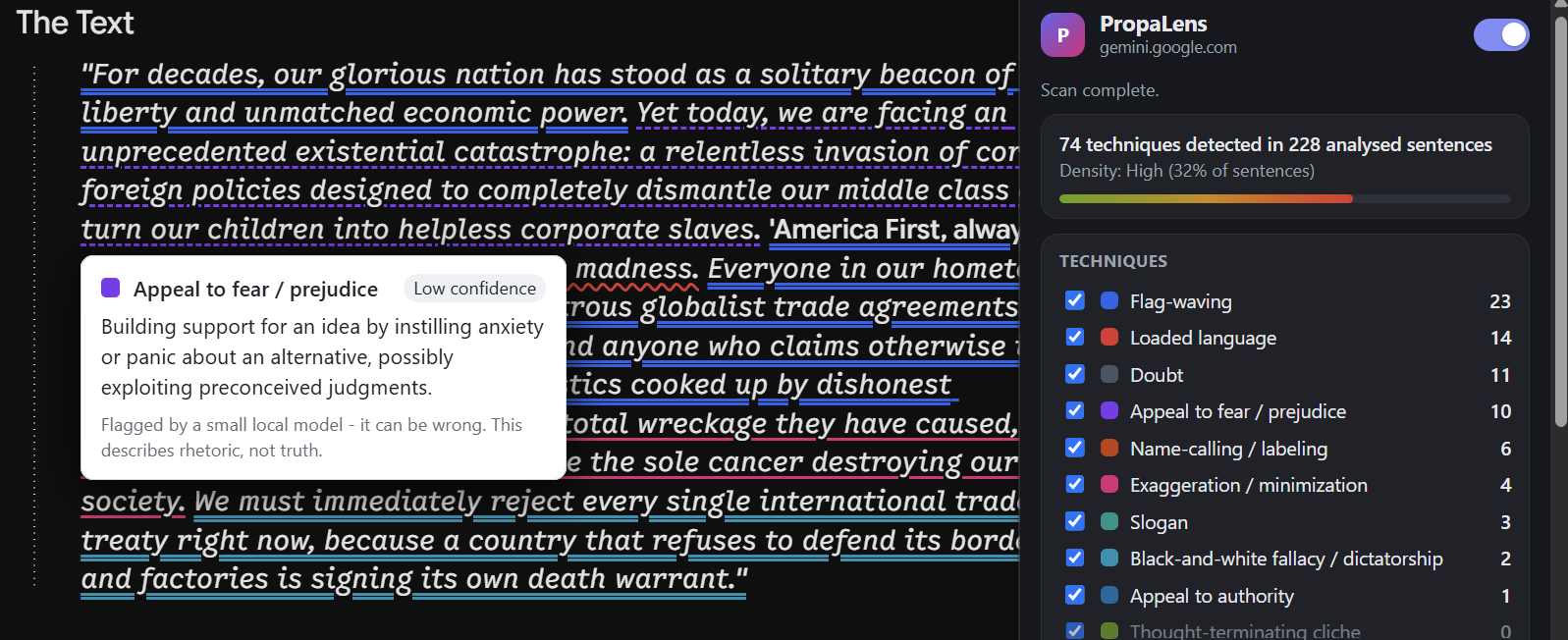
Each flagged sentence gets a coloured underline. The colour shows the technique.
 PropaLens
PropaLens underlines sentences that use one of 14 known persuasion techniques, such as Loaded languageHigh confidence Words or phrases with strong emotional implications, positive or negative, used to influence the audience. Flagged by a small local model - it can be wrong. This describes rhetoric, not truth. or Appeal to fear / prejudiceHigh confidence Building support for an idea by instilling anxiety or panic about an alternative, possibly exploiting preconceived judgments. Flagged by a small local model - it can be wrong. This describes rhetoric, not truth. , right in the article, with the definition one hover away. Each highlight is a signal to pause and check a claim. Free, and your reading never leaves your device.
Free. Experimental: the model makes mistakes, so treat highlights as a prompt to read more closely.
YouTube playback only loads when you press play.
Each flagged sentence gets a coloured underline. The colour shows the technique.
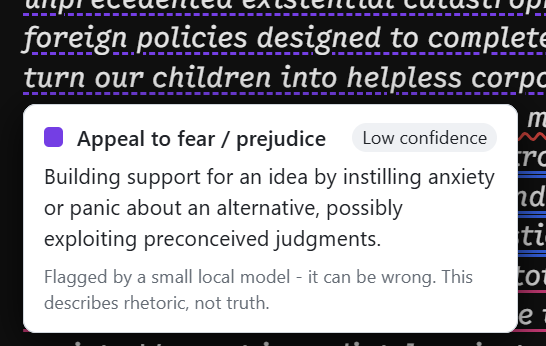
Hover or tap an underline to see the technique name, a one-line definition and a Low, Medium or High confidence level.
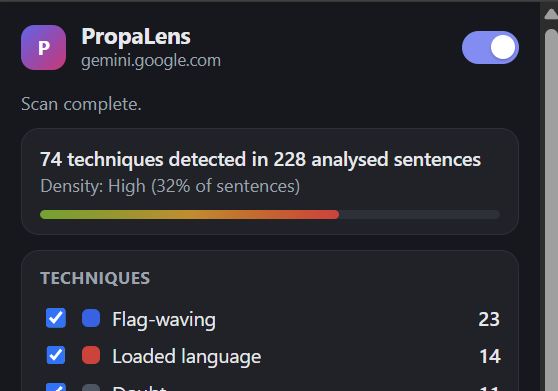
The popup lists the techniques found with counts. You can hide a technique or jump to the next example.
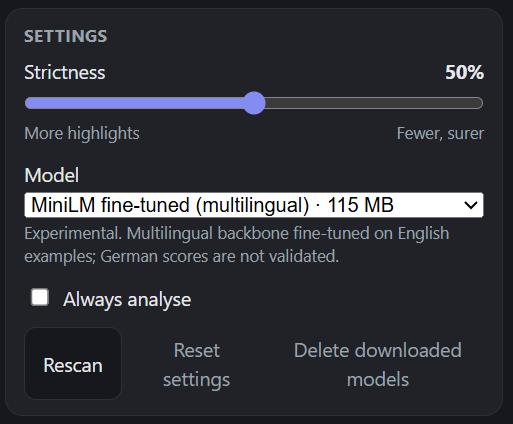
A slider trades coverage for reliability: fewer highlights that are more often correct, or more highlights that include more false alarms.
Showing features 1 and 2 of 4: Underlines in the page and Short explanation on hover.
Persuasive techniques lose much of their power the moment you recognize them. PropaLens flags a technique while you're reading — when it can still change your mind about how you feel — instead of leaving it invisible. Over time, the hover-card definitions act like spaced practice: you learn the techniques and start spotting them on your own, with or without the extension.
At the default 50% strictness, the bundled models reached about 58–60% precision and 76–77% recall on our English validation set. That means roughly six in ten highlights were correct, while the models found around three quarters of the labelled propaganda sentences in this test. The set contains 2,087 held-out sentences derived from the PTC corpus; its original span annotations were assigned to sentences for evaluation. The included models are fine-tuned MiniLM and XLM-RoBERTa. The precision/recall chart shows results across strictness settings, and the F1 chart combines those measures into one score. A higher setting gives fewer highlights that are more often right. Results on other kinds of text will differ.
The models are fine-tuned classifiers built from two public datasets. We changed the data as follows:
SemEval-2020 Task 11 (PTC corpus): Da San Martino,
Barrón-Cedeño, Wachsmuth, Petrov and Nakov, 2020.
Dataset,
paper.
Licensed CC BY 4.0.
PropXplain: Alam et al., Findings of EMNLP 2025.
Dataset,
paper. MIT License.
We modified the data as described above. This project is not
endorsed by the dataset authors.
Planned
We are considering an optional hosted service that uses a larger model and explains why a sentence was flagged (hosted by us). Leave your email if you want to hear when there is something to try. We will only use it for this.
We only use your email to tell you about PropaLens Cloud. See the .